In-situ Superconducting Qubit Flux Line Characterization and Precompensation in a Few Lines of Code
Motivation and Introduction
In this blog post, we present a guide to characterize and compensate flux-line distortions in superconducting qubit devices using the Zurich Instruments HDAWG with the Real-Time Precompensation Option. Through in-situ measurements on real qubits, we demonstrate how this is conveniently implemented and used within the LabOne Q quantum computing control software framework. Our approach is simple and efficient, as it enables the compensation for flux-line distortions in a few lines of code while LabOne Q ensures correct pulse timings in the background. This allows scientists and engineers to focus on their experiments while benefitting from optimal gate fidelities through precise shaping of flux pulses sent to the qubits.
Flux pulses can be generated with high precision using Arbitrary Waveform Generators (AWGs) such as the HDAWG or SHFSG from Zurich Instruments. However, various electronic components in the signal line can distort the control pulses on their path to the qubits, thereby compromising gate fidelities, see Figure 1(a). One common way to correct linear distortions is through pulse precompensation: instead of generating a pulse with the desired shape, the shape is modified to precisely counteract the distortions by the signal line. The final pulse at the qubit is then distortion-free, see Figure 1(b).
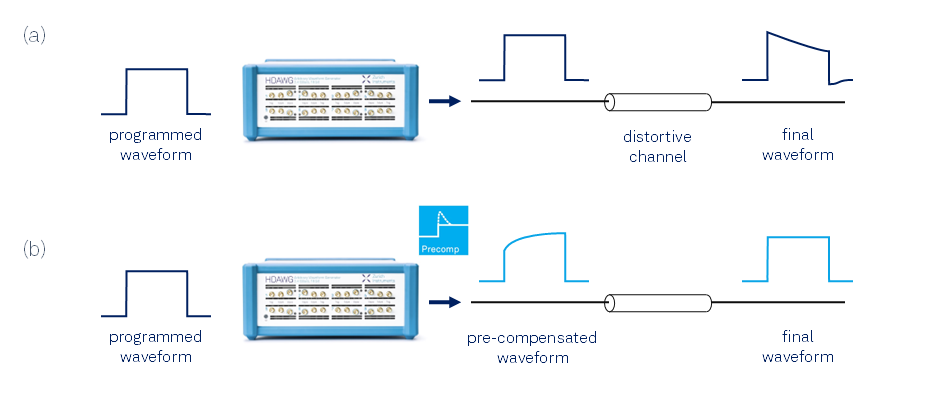
A possible way to perform such precompensation is by calculating the pulse shape offline, prior to uploading the waveforms to the AWG. However, in situations where the waveforms need to be adapted depending on feedback (e.g. for quantum error correction), this requires uploading the waveforms corresponding to all possible branching cases. Similarly, subsequent repetitions of the same experimental sequence may call for different flux pulse precompensations if the time constant of the distortions is very long, even without feedback. These situations may require an amount of waveform memory exceeding the instrument constraints and making this approach unfeasible in practice. To address this challenge, Zurich Instruments introduced the Real-Time Precompensation Option for the HDAWG to provide a scalable solution with an economic use of the waveform memory: all generated pulses are precompensated in real-time by passing through digital filters within the instrument, see Figure 2.