Boxcar Averagers
Boxcar averagers are effective tools to achieve a high signal-to-noise ratio (SNR) in a minimal amount of measurement time when working with low-duty-cycle signals. Such signals contain relevant information only in a fraction of each period; outside that fraction, only noise is present. Capturing low-duty-cycle signals with high quality and the ability for real-time feedback is crucial for many applications in optics and photonics, nanotechnology and materials science, quantum technologies, scanning probe microscopy, and sensing.
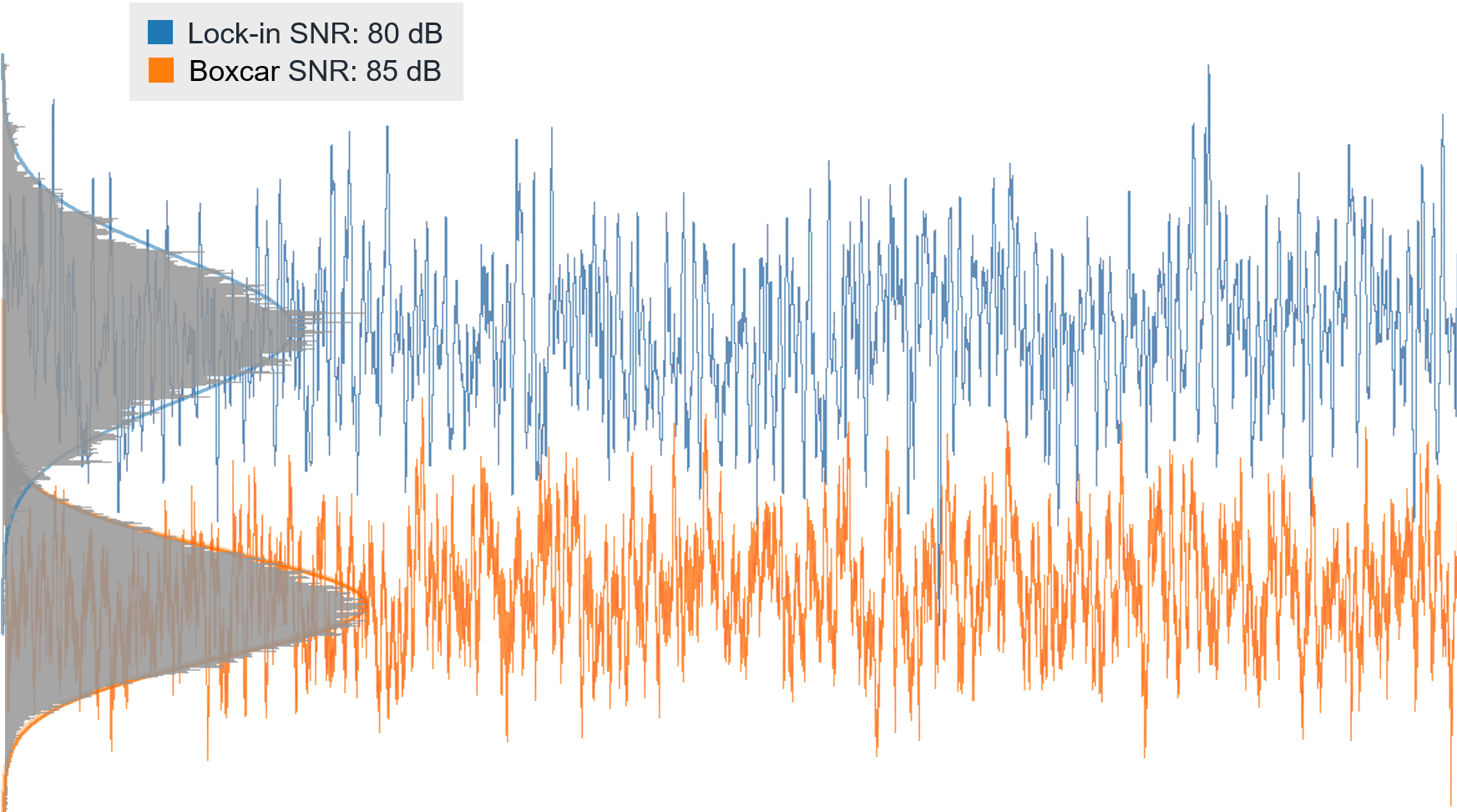
The graphic below illustrates the principle of boxcar averaging: limiting the measurement to a well-defined temporal window in each period (in grey) means that all signal components outside of that window are rejected.
Unlike a regular digitizer or an oscilloscope, the measurement results are immediately available in the digital domain and as analog signals with a user-defined offset, and scaling factors. Moreover, integrated PID controllers can process the results to create feedback loops and the lock-in amplifier units can perform additional demodulation on the boxcar results if an additional modulation is present.
Our white paper on the principles of boxcar averaging offers a more detailed discussion.
Boxcar Averager for Lock-in Amplifiers
The Zurich Instruments Boxcar Averager operates as a high-speed digitizer synchronized to a reference oscillator that is phase-locked to the periodicity of the experiment. In the case of the laser repetition rate, for example, every data sample recorded at the input can be associated with the phase of the experiment, and the signal components not synchronized with the experiment are strongly suppressed. The implementation based on an external reference signal removes the trigger jitter, and the digital realization enables a dead-time-free operation.


LabOne instrument control software
Boxcar measurements are easily set up and optimized with the LabOne® instrument control software.
UHF-BOX Boxcar Averager
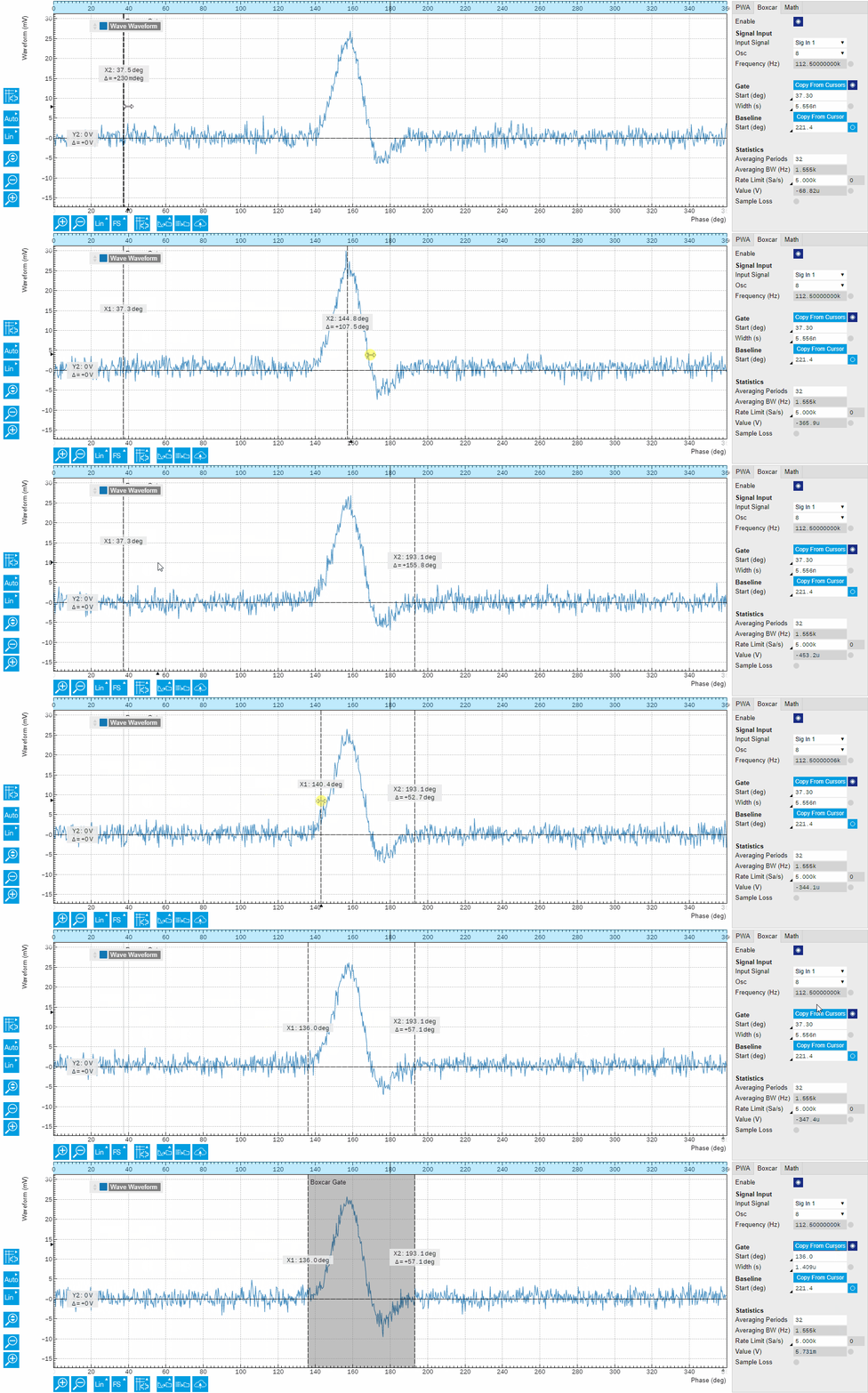
The graphical user interface of the UHF-BOX Boxcar Averager offers a rich toolset, including a periodic waveform analyzer (PWA): the PWA displays the signal with a user-controllable averaging amount to enable straightforward operation of the boxcar averager with both high and low SNR signals. With this tool, setting the boxcar windows only requires users to delimit the time interval to be measured with the cursors, as shown in the graph above.
MF-BOX Boxcar Averager
The configuration of the boxcar window on the MF-BOX Boxcar averager can be achieved with either the Scope or the Sweeper. The configuration with the Scope can be very convenient, especially in cases where the amplitude of the pulse train is well above the noise floor. Alternatively, the Sweeper approach is particularly advantageous when the SNR of the pulse train is too low for clear visualization on the Scope, as it allows for improved SNR by sweeping the Start position of the boxcar gate. This offers a better pulse profile than a single Scope snapshot would.
User Benefits
- Save time on high-quality measurements of low-duty-cycle signals.
- Choose the best-suited technique for every new experiment: boxcar averaging, lock-in detection, or both.
- Demanding schemes and methods such as double modulation, baseline suppression, and feedback loop operations become straightforward to implement thanks to the LabOne toolset.