Time Domain Thermoreflectance (TDTR)
Related products: MFLI, HF2LI, UHFLI, MF-MD, HF2LI-MF, UHF-MF, MF-MOD, HF2LI-MOD, UHF-MOD, UHF-BOX
Application Description
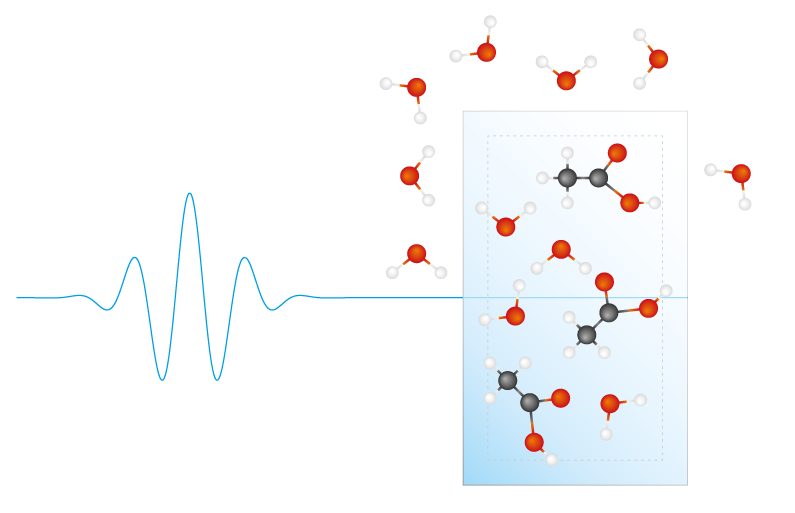
Time-domain thermoreflectance (TDTR) is a technique used to characterize the thermal properties of thin films or bulky materials. The measured data can help improve the understanding of transport processes driven by phonons and electrons. In typical TDTR experiments using ultrafast laser sources, a modulated pump pulse and a subsequent time-delayed probe pulse are shone onto the sample surface. The induced thermoreflectance response is then measured as a function of the time delay between the pump and probe pulses. Taking advantage of ultrashort laser pulses and pump-probe detections allows quantities like thermal conductivity or volumetric heat capacity to be measured with ps or even sub-ps time resolution.
Frequency-domain thermoreflectance (FDTR) is a variation of TDTR in which the thermoreflectance signal is measured as a function of the modulation frequency of the pump beam, rather than the delay time between the pump beam and the probe beam. FDTR can measure the same thermal properties as TDTR using either pulsed lasers or CW lasers. The main advantages of CW-FDTR measurements are avoiding expensive and delicate pulsed laser systems and eliminating error-prone mechanically moving parts in the setup. Additionally, proper selection of the modulation frequency is essential for accurate TDTR measurements but less crucial for FDTR.
For both FDTR and TDTR, different heat transfer processes can be investigated by changing the pump beam modulation frequency.
Measurement Strategies
The measured signals in TDTR and FDTR are periodic and remarkably small; therefore a fast and high-quality lock-in amplifier is a key requirement for achieving a large signal-to-noise ratio (SNR). Another attractive measurement approach for the pulsed laser schemes consists in employing fast photodetectors in combination with boxcar averaging. This allows the signal to be recorded only during the short duty cycle of the experiment and therefore excludes the vast amounts of data recording time during which only noise is present.
TDTR measurements
As a result of the periodic heat flux induced by the pump beam, the probe beam detects the corresponding temperature change through the change in sample reflectance in a time-resolved manner. The pump beam is usually modulated at a frequency in the range 0.2 - 20 MHz using an electro-optic modulator (EOM). It is then directed onto the sample through an objective lens, together with the delayed, collinear probe pulses. A photodetector and a lock-in amplifier then measure the reflected signal. The typical experimental configuration is depicted in Figure 1.
Due to the small signals, TDTR turns out to be technically challenging and requires sensitive electronics and heavy averaging to achieve good SNR.

FDTR measurements
The TDTR setup can easily be switched to perform pulsed-laser FDTR by sweeping the modulation frequency of the pump beam over several tens of MHz while keeping the position of the delay stage fixed. In pulsed FTDR and CW-FTDR (experimental layout in Figure 2), the optical detector and the signal processing electronics measure the signal as a function of the pump beam modulation frequency. The speed at which the modulation can be varied is typically limited by the available SNR. Using a lock-in amplifier that can cover the full modulation range and has a sensitive input with low noise is crucial to achieving good results quickly and reliably.

Product Highlights


The Benefits of Choosing Zurich Instruments
- Faster measurements with higher SNR: low input noise, fast sampling rate, and state-of-the-art digital signal processing of the HF2LI and UHFLI Lock-in Amplifiers are ideal for measuring TDTR and FDTR weak signals.
- Large frequency range: sweep across the desired values of modulation and demodulation frequency. This is crucial for FTDR, as the thermal dynamics on the sample depend on the modulation frequency.
- For short laser pulses at low repetition rates, as employed in some TDTR experimental setups, boxcar averaging leads to better SNR than a lock-in measurement. The UHF-BOX Boxcar Averager option gives access to both measurement possibilities simultaneously, within the same instrument.
- Simultaneous measurements of up to 2 photodetector signals with the H2FLI and the UHFLI, in case an additional reference photodetector is used.
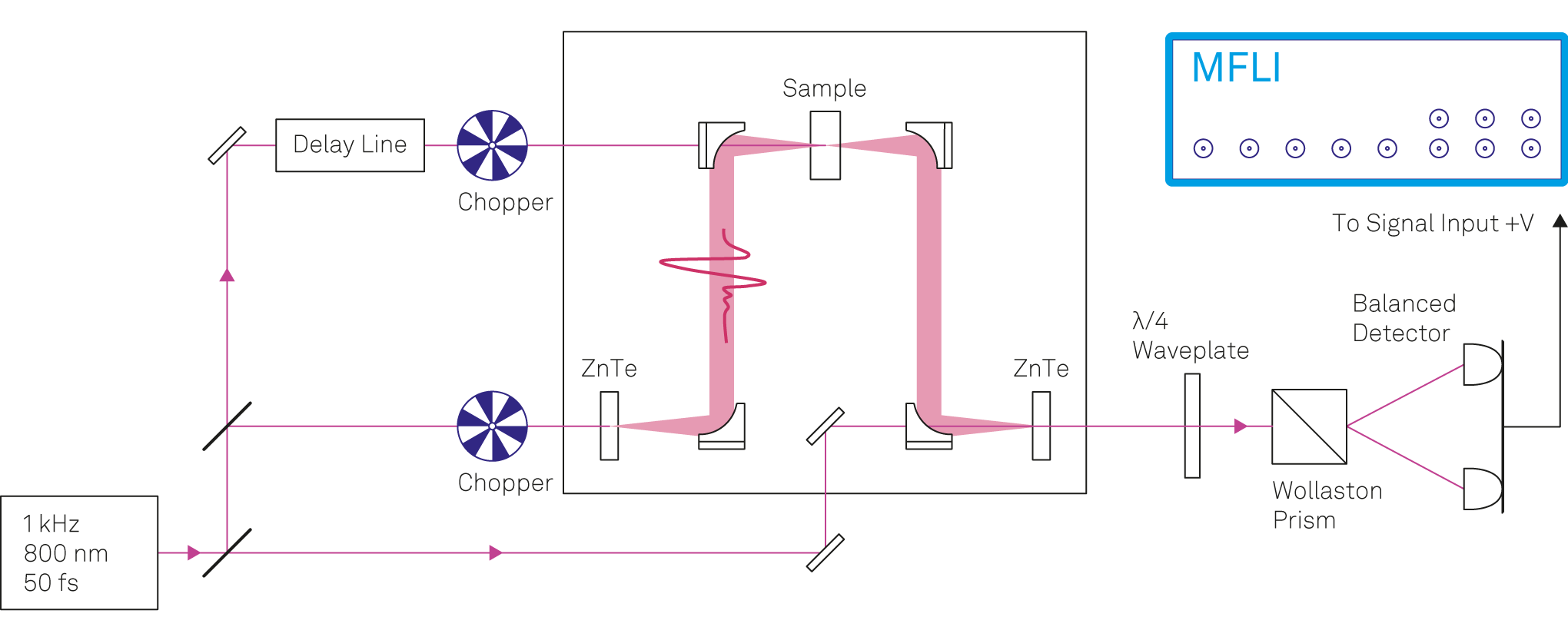
- Adding an additional modulator to the probe beam, e.g. in the broadband-FDTR (BB-FDTR) or double-modulation TDTR experimental implementation (Figure 3), helps remove the signals created by scattering of the pump beam from roughness or defects on the sample surface. This additional modulation, coupled with the UHF-MF and HF2-MF Multi-Frequency option and/or the UHF-MOD and HF2-MOD AM/FM Modulation option, can help you reliably extract all the signal components in parallel with high data quality.