Superconducting Fluxonium Qubits
Related products: QCCS, SHFQC, SHFSG, SHFQA, SHFPPC, HDAWG, PQSC, QHub, LabOne Q
Application brief: Superconducting Fluxonium Qubits. Controlled.
Application Description
Superconducting fluxonium qubits are among the leading qubit candidates for building useful quantum computers. Since their first realization in 2009, research on fluxonium qubits has demonstrated great progress in improving qubit coherence times, control efficiency, and coupling architectures. Following the growing number of academic research groups, the industrial startup Atlantic Quantum is the first to focus on this technology, owing to the fluxonium's exceptional potential for enabling high-fidelity qubit operations.
Like the more widely used transmon design, fluxoniums rely on the anharmonicity of a Josephson junction to engineer individually addressable quantum states of a superconducting circuit, and on a shunting element to suppress sensitivity to environmental charge noise.
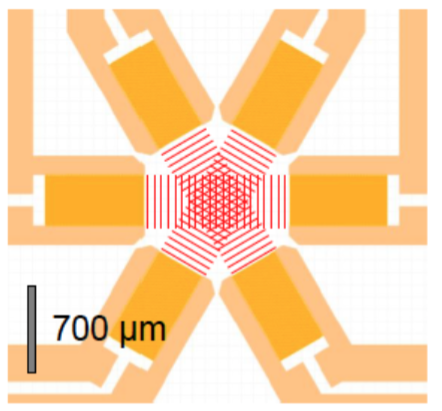
The key advantage that fluxoniums have over transmons is that it is possible to optimize two important quantities independently of each other: a large anharmonicity for fast state control and a large noise insensitivity for long coherence times. This is achieved by using a superinductor instead of a capacitor as the shunting element. The superinductor is typically realized as a chain of large Josephson junctions.
Current research focuses on these topics:
- Optimizing fabrication and design for higher yield and lower intrinsic losses
- Two-qubit gate technologies
- Scalable architectures
Measurement Strategies
Fluxonium circuits and transmon qubits share many requirements for control and measurement, with the following exceptions:
- Fluxonium artificial atoms have tunable energy level structures, depending on a DC magnetic flux bias.
- The computational basis states of fluxoniums have a frequency separation of typically 10 to 750 MHz. This is much lower than typical transmon qubit transition frequencies, which often lie between 3 and 6 GHz.
- The energy level structure of fluxoniums has a large anharmonicity, with the higher excited states separated from computational basis states by several GHz. Transmons, in turn, can be treated as weakly anharmonic quantum oscillators.
- Fluxoniums can be coupled to their control and readout circuitry through either electric charge or magnetic flux degrees of freedom.
- Measurement-based reset is essential for removing thermal population from the first excited state of a fluxonium due to its low qubit transition frequency.
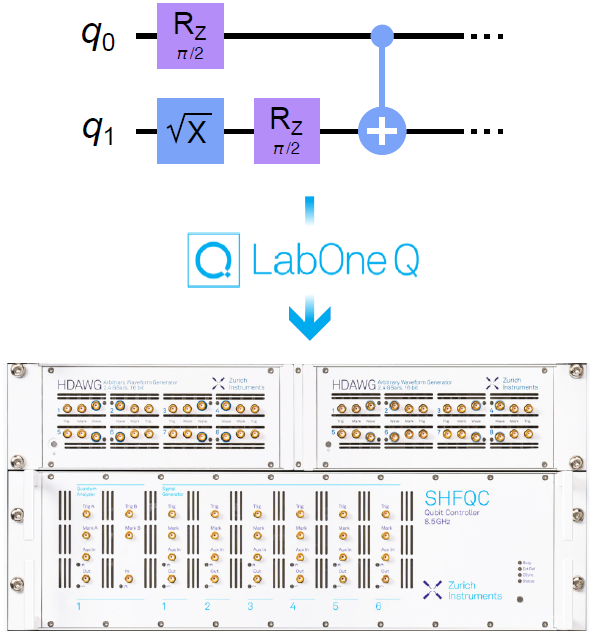
The Zurich Instruments QCCS represents the state of the art for controlling fluxonium-based quantum processors. It provides users with a flexible yet scalable system covering all needs for qubit control, readout, and feedback. Setups of all sizes are controlled through the LabOne Q software, providing hardware abstraction, an experiment control framework, and an interface to higher software layers. Zurich Instruments' solutions provide key features that particularly benefit fluxonium qubit experiments in the following experimental methods:
Qubit control and readout
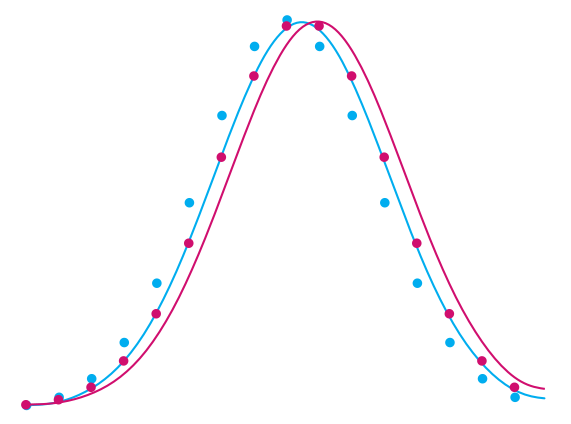
- Fast and parallel spectroscopy and coherence time measurements of fluxonium qubits and their microwave readout resonators
- Control of the computational basis states with the HDAWG Arbitrary Waveform Generator through direct digital synthesis below 750 MHz
- Transition to higher, non-computational levels up to 8.5 GHz driven by the SHFQC+, with a direct extension to higher frequencies using external microwave mixers
- Control of cryogenic quantum-limited microwave parametric amplifiers by using the SHFQC+ Qubit Controller with the SHFPPC Parametric Pump Controller
- Fast and accurate magnetic flux control for fluxoniums using the HDAWG
- Efficient system calibration orchestrated by the quantum control software framework LabOne Q
High-fidelity two-qubit gates
- Microwave pulse sequences generated by the SHFQC+ for controlling capacitive, inductive, or qubit-based coupler elements between fluxoniums
- Leading output signal-to-noise ratio with the SHFQC+ for highest entanglement gate fidelities
- Multiple instruments synchronized by the PQSC or QHub for controlling scalable fluxonium quantum processors
Measurement-based qubit reset
- Low-latency feedback within the SHFQC+ for real-time adaptive microwave control pulse generation based on qubit readout results
- Global low-latency feedback via the PQSC for measurement-based control sequence generation using the SHFQC+ and the HDAWG
- Scalable quantum feedback system in a star network architecture centrally synchronized by the PQSC or QHub
Programming Resources
The LabOne Q control software framework comes with examples for a large number of measurement methods for superconducting qubits. Check out our Applications Library to find out how to implement the methods below, and many more.
- Fast resonator or qubit spectroscopy
- Single- and two-qubit gate tuneup
- Randomized benchmarking
- Active qubit reset
The LabOne Q Applications Library enables you to quickly ramp up your qubit experiments and focus on the physics and results that interest you. With this framework, you get the tools to describe your measurements in terms of quantum devices and their operations. The Applications Library covers all parts of a tune-up workflow: experiment definition, measurement, analysis and plotting, and physics parameter updates.

The Benefits of Choosing Zurich Instruments
- Rely on excellent analog signal properties for fluxonium qubit control with the HDAWG: low noise floor, low crosstalk, high vertical resolution
- Benefit from our application know-how in a broad spectrum of quantum physics and engineering, including different architectures of superconducting quantum computing
- Rely on a partner with long-standing excellence in test and measurement instrumentation and a renowned customer base in quantum information technologies
- Get all microwave control and readout channels for fluxonium qubits in one solution, with full flexibility in frequency
- Program your experiments efficiently and intuitively with LabOne Q without worrying about hardware details
- Build on a clear roadmap for scaling and for integrating high-level quantum stack software, e.g. Qiskit
- Maximize control and readout fidelity with state-of-the-art signal purity and a 1 GHz instantaneous bandwidth
- Get access to powerful low-latency feedback methods via a high-level programming interface