Spin-Based Quantum Computing
Related products: HDAWG, UHF + AWG, MFLI + MD + DIG
Application brief: Spin-Based Quantum Computing. Controlled.
Application Description
Spin-based quantum computing is a leading technology for the realization of scalable quantum computers. Semiconductor quantum dots (QDs) are used to trap individual charges and the associated spins, which are then used as qubits. The Zurich Instruments Quantum Computing Control System (QCCS) provides all the key tools for spin qubit characterization, control and readout, providing a low-noise and scalable solution that improves setup reliability and simplifies setup control.
Single spins are confined in semiconductors quantum dots. Metallic gates define them and control the relative couplings. A large quantum dot is used as a charge sensor for the smaller ones which are serving as qubits. Single qubit operations are induced through an oscillating magnetic field coupled to the qubits through microwave strip lines. Two qubits gates can be realized with fast pulses on those metallic gates which are close to two quantum dots.
Measurement Strategies
Quantum-dot characterization
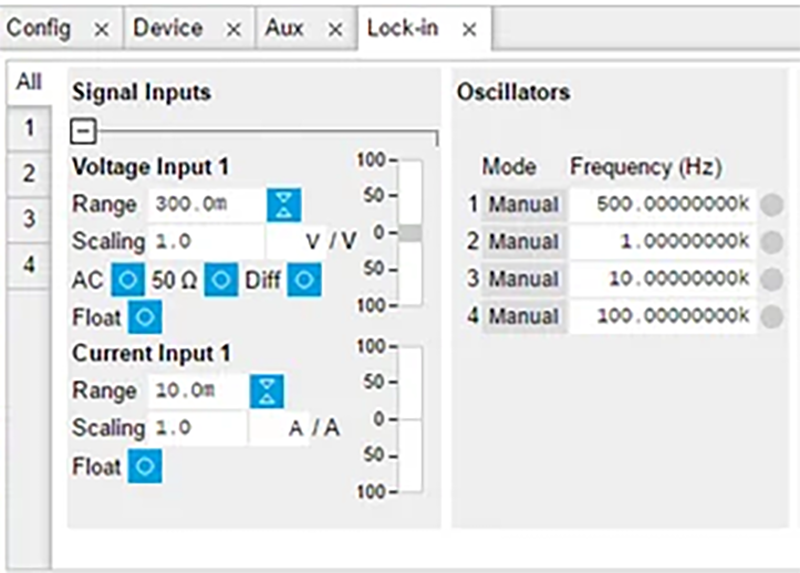
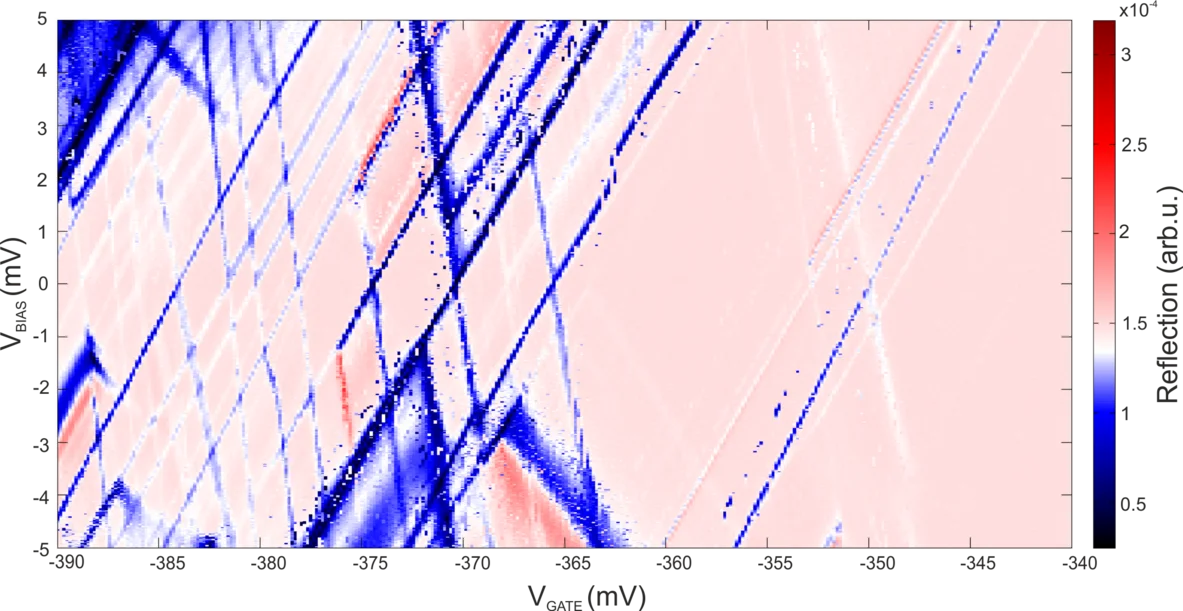
The MFLI Lock-in Amplifier is used for quantum dot characterization. The integrated low noise current amplifier is able to amplify the small current flowing through a typical QD and the multiple oscillators are set to different frequencies to simultaneously acquire DC conductance, low-frequency conductance and gate trans-impedance. The digitizer function can be used to acquire fast current traces to perform single-shot spin readout.
Fast multiplexed qubit control
The HDAWG multi-channel Arbitrary Waveform Generator generates the fast pulses for the metallic gates which are used to control the QD energy levels and couplings and to drive the two-qubit gates. To counteract the effect of cross-coupling, additional pulses are applied to multiple gates. The HDAWG is able to modulate the microwave source in order to produce single-qubit gates. Different qubits can be addressed with frequency multiplexing.
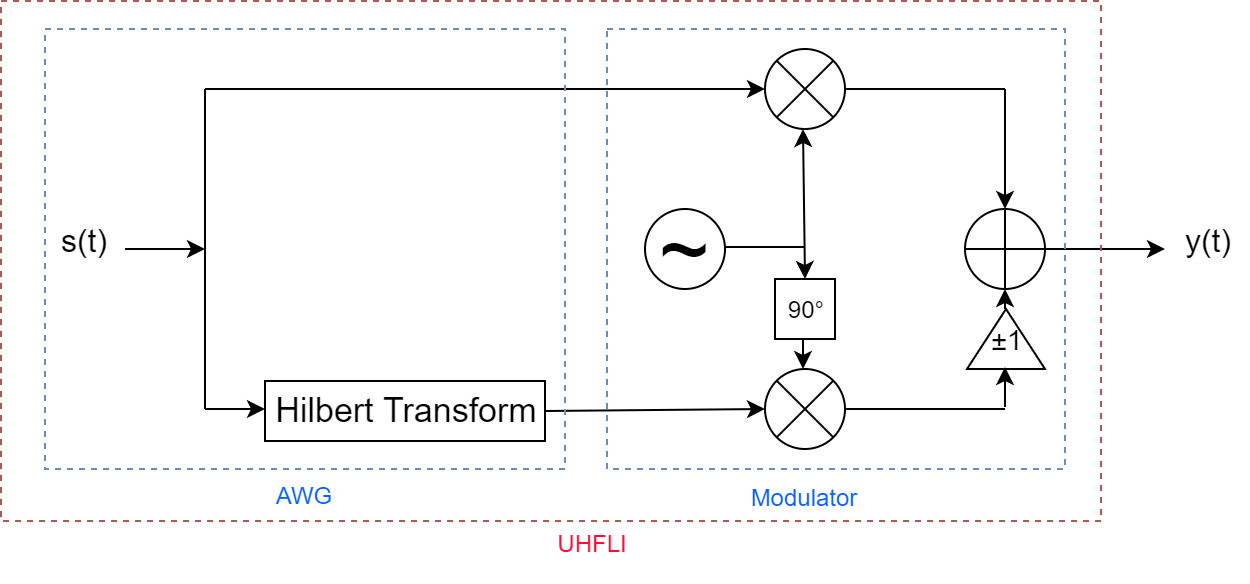
A single-sideband modulation scheme, in conjunction with the internal oscillators, suppresses unwanted images and facilitates a clean spectrum.
High-fidelity readout
The spin-readout speed is greatly improved when performed at high frequency with RF reflectometry. The UHFLI Lock-in Amplifier generates the probe RF readout tone and acquires the reflected response of the sensing QD to perform fast and high-fidelity single-shot spin readout. Up to eight sensing dots can be multiplexed and read simultaneously. The magnitude or the phase of the demodulated signals is a measure of the complex impedance of the charge sensor, from which the qubit state can be measured.
Programming Resources
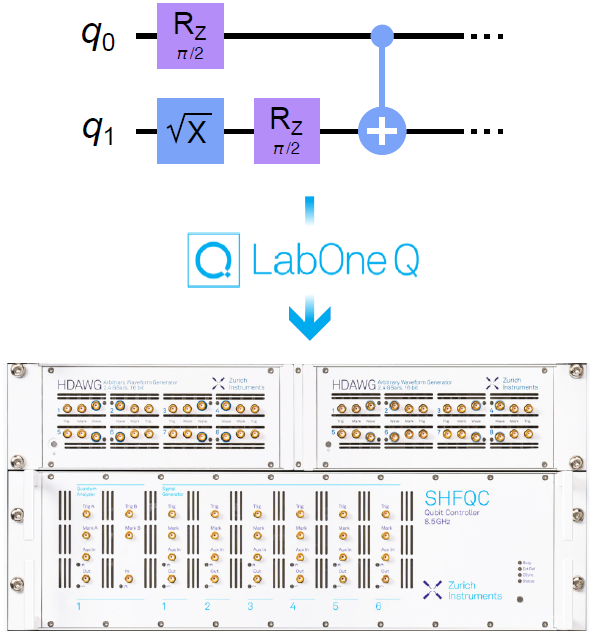
The LabOne Q control software framework comes with examples for a large number of measurement methods for semiconductor spin qubits. Check out our Applications Library to find out how to implement the methods below, and many more.
- 2D parameter sweeps
- Rabi flopping: pulse length sweep
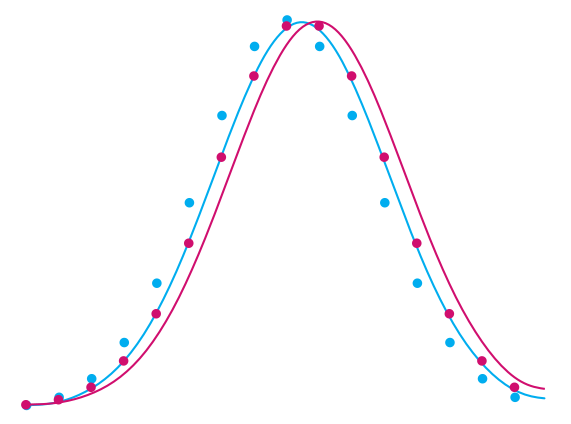
- Ramsey: phase and delay sweeps
- Pulsed lock-in amplifier acquisition with /node/487 and /node/97
The LabOne Q Applications Library enables you to quickly ramp up your qubit experiments and focus on the physics and results that interest you. With this framework, you get the tools to describe your measurements in terms of quantum devices and their operations. The Applications Library cover all parts of a tune-up workflow: experiment definition, measurement, analysis and plotting, and physics parameter updates.

Product Highlights

The Benefits of Choosing Zurich Instruments
The QCCS provides all the critical components to characterize and control a complex spin qubit system.
- A high level of integration guarantees low setup complexity and maintenance effort:
- Current amplifier, multimeter, lock-in amplifier and digitizer are found in a single unit.
- Reflectometry readout with unified signal generation and detection is performed without the need for external analog up-/down-conversion.
- A reduced need for isolation and filtering leads to low power dissipation at the input connectors.
- The LabOne APIs, with drivers for Labber and QCoDeS, enable fast integration into your control environment and existing setup.
- Experience accurate spin control and enhanced fidelity, also for fast qubits, thanks to the fast and low-noise HDAWG outputs.
- You can run advanced and complex experiments with the real-time sequencer.
- Gain access to a clear pathway to larger numbers of qubits: control many multiplexed qubits with the internal oscillators and the large output bandwidth.
The QCCS is a future-proof investment that optimizes your workflows and setup performance.