Understanding the Specifications of Lock-in Amplifiers
Today, lock-in amplifiers are widespread instruments used to measure small signals buried in noise. Thanks to their versatility, they can be tailored to different experiments and address a large variety of applications. From optics and photonics to impedance analysis, they are present in many research and development labs, helping researchers and engineers to run faster and more precise experiments.
To find the instrument that best suits your needs, it is important to understand the specifications of a lock-in amplifier. While the focus of this blog post is on hardware specifications, you should keep in mind that software analysis tools and features are an equally relevant part of the measurement setup.
For an exhaustive and rigorous introduction to the principles of lock-in detection, you can watch this video or refer to our white paper.
In this blog post, we will look closely at the following specifications:
- Instrument frequency range (input/output)
- Sampling rate and vertical resolution
- Sensitivity
- Input voltage noise
- Dynamic reserve
- Demodulation bandwidth and time constant
Instrument Frequency Range (Input/Output)
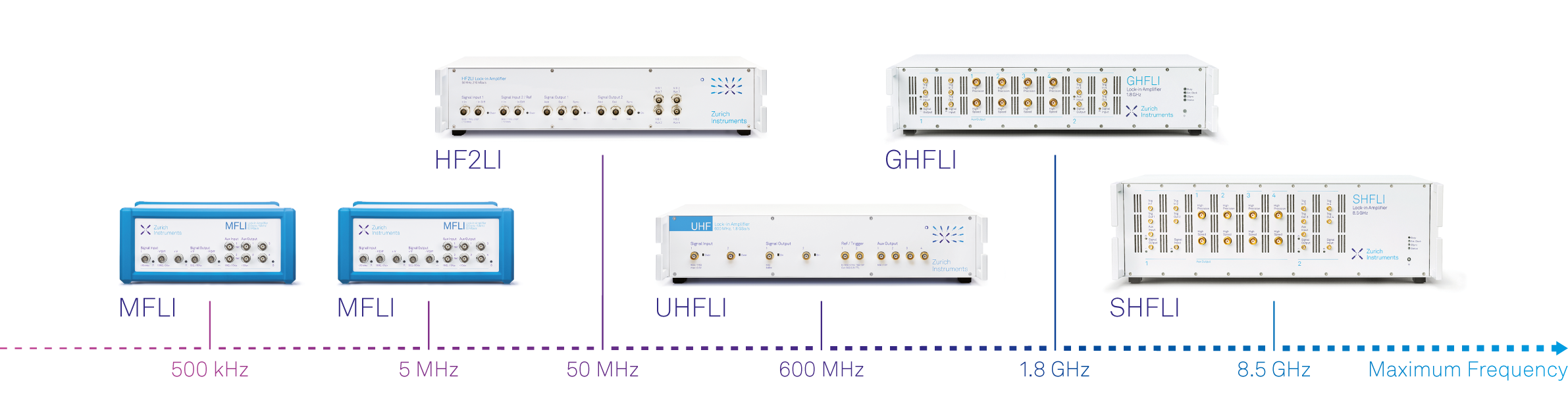
The instrument frequency range defines the range of frequencies that a lock-in amplifier can correctly analyze and use to demodulate an input signal. All of Zurich Instruments' lock-in amplifiers can handle signals spanning from DC (0 Hz) to the maximum frequency rating of the considered instrument:
- MFLI: DC - 500 kHz
- MFLI: DC - 5 MHz
- HF2LI: DC - 50 MHz
- UHFLI: DC - 600 MHz
- GHFLI: DC - 1.8 GHz
- SHFLI: DC - 8.5 GHz
Additionally, our instruments are equipped with signal outputs – one or two per instrument, depending on the device – able to generate sinusoidal signals with a frequency that can be freely chosen within the instrument's frequency range.
With the UHFLI, and in the future with the GHFLI and SHFLI too, it is possible to output not only sinusoidal signals but also arbitrary waveforms when using the UHF-AWG Arbitrary Waveform Generator option.
Sampling Rate and Vertical Resolution
Lock-in amplifiers measure analog signals. However, modern lock-in amplifiers (such as Zurich Instruments') carry out all operations in the digital domain thanks to field-programmable gate array (FPGA) technology and digital signal processing (DSP) techniques. Therefore, an essential component for lock-in amplifiers is the Analog to Digital Converter (ADC), whose purpose is to convert the analog input signal to the digital domain by sampling it and digitizing it with a given sampling rate and vertical resolution, respectively. Let's have a closer look at these two parameters.
Sampling rate
The sampling rate of an instrument indicates how many times per second the ADC samples the input analog signal. According to the Nyquist theorem, to correctly resolve a continuous signal at a given frequency f one must sample the signal at a rate that is at least double that frequency, i.e., use a sampling rate of 2f. If this requirement is not met, the original signal cannot be properly reconstructed due to artifacts such as aliasing. The effect of improper sampling can be seen in Figure 2, where a signal at a given frequency can be aliased if sampled with a sampling rate that's too low.
For example, the HF2LI has a sampling rate of 210 MSa/s, which is over 4 times larger than the 50 MHz maximum input frequency. The reason for this oversampling (theoretically, a sampling rate of 100 MSa/s would be enough for a 50 MHz signal) is to improve anti-aliasing performance, increase resolution, and reduce noise.